
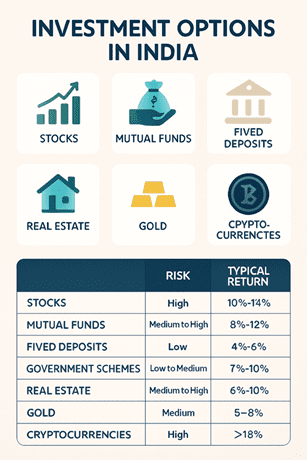

Investing wisely is the key to growing your wealth and securing a financially comfortable future. But with so many investment options available in India, it’s easy to feel overwhelmed. From safe government-backed schemes to exciting market-linked opportunities, each option serves a different purpose depending on your goals and risk appetite. This guide breaks down popular investment types, their risk levels, typical returns, and how they can help you build wealth in 2025.
Market-Linked Investments: For Growth Seekers
If you’re comfortable with some risk and want your money to grow significantly over time, market-linked investments can be rewarding.
- Stocks (Equities): Gain ownership in companies, with returns coming from capital growth and dividends. Expect higher volatility but potentially the highest long-term returns.
- Mutual Funds: Professional management of pooled money invested across equities, bonds, or hybrid assets. Great for diversification, and easier than picking individual stocks.
- Exchange-Traded Funds (ETFs): Trade like stocks but represent a basket of assets such as indices or commodities, offering simplicity and cost efficiency.
- Unit Linked Insurance Plans (ULIPs): Combine insurance with market-linked investments, giving the potential for higher returns along with life cover.
- REITs and InvITs: Invest indirectly in real estate and infrastructure projects, benefiting from rental incomes and capital appreciation without physical property hassles.
Fixed Income & Government Schemes: Stability and Security
If peace of mind and steady returns matter most, consider these low-risk investments.
- Fixed Deposits (FDs): Bank or post office deposits with guaranteed interest rates. Ideal for capital preservation and predictable income.
- Recurring Deposits (RDs): A disciplined savings approach by depositing a fixed amount monthly with assured returns.
- Government Bonds & Treasury Bills: Safest debt instruments issued by the government, offering fixed or variable returns.
- National Savings Certificate (NSC): A popular 5-year government savings scheme offering fixed interest and tax benefits.
- Kisan Vikas Patra (KVP): Doubles the invested amount over a fixed period (around 9 years), backed by the government.
- Senior Citizens Savings Scheme (SCSS): Designed for retirees, offering one of the highest government-backed interest rates.
- Public Provident Fund (PPF): Long-term (15 years) tax-free savings scheme with attractive interest rates.
- Employees’ Provident Fund (EPF): Mandatory retirement savings for salaried individuals with employer contribution.
- Sukanya Samriddhi Yojana: Savings scheme for girl child with better interest rates and tax benefits.
Alternative and Emerging Investments: Modern and Diverse
Looking beyond traditional options?
- Real Estate: Physical property investment offers rental income and capital gains but requires a larger capital outlay.
- Gold and Silver: Timeless wealth preservers in physical form, ETFs, or sovereign gold bonds.
- Fractional Real Estate: Own portions of high-value properties, making real estate accessible with smaller investments.
- Collectibles and Digital Assets: Art, vintage wine, NFTs, etc., ideal for diversifying but suitable only if you understand the risks.
Excel: Your Investment Planning Partner
No matter what investments you pick, tracking and calculating your returns is easier with tools like Excel. It allows you to:
- Organize all investments in one place
- Calculate growth and maturity amounts using formulas
- Plan for future financial goals with projections
Investing isn’t just about choosing the right products, but also about staying informed and organized.
Summary Table: Investment Types, Risk Levels & Typical Returns
| Investment Type | Risk Level | Typical Returns (Annual) |
|---|---|---|
| Stocks (Equities) | High | 12% – 15% |
| Mutual Funds (Equity) | Medium-High | 10% – 14% |
| Exchange Traded Funds (ETFs) | Medium-High | 9% – 13% |
| Unit Linked Insurance Plans (ULIPs) | Medium-High | Varies, often 8% – 12% |
| REITs & InvITs | Medium | 8% – 12% |
| Fixed Deposits (FDs) | Low | 6% – 7.5% |
| Recurring Deposits (RDs) | Low | 6% – 7.5% |
| Government Bonds & T-Bills | Very Low | 6.5% – 7.5% |
| National Savings Certificate (NSC) | Low | ~7.7% |
| Kisan Vikas Patra (KVP) | Low | ~7.2% |
| Senior Citizens Savings Scheme (SCSS) | Low | ~8.2% |
| Public Provident Fund (PPF) | Low | ~7.1% |
| Employees’ Provident Fund (EPF) | Low | ~8.5% |
| Sukanya Samriddhi Yojana | Low | ~8% |
| Real Estate | Medium | 8% – 12% |
| Gold & Silver | Low – Medium | 6% – 8% |
| Fractional Real Estate & Collectibles | High | Highly Variable |
Investing is a journey tailored to your goals, comfort with risk, and timeline. By understanding the options available, from the safest government schemes to growth-focused market investments, you can craft a portfolio that grows your wealth steadily and safely over time.
Start early, stay consistent, and keep learning. Your financial future will thank you!