
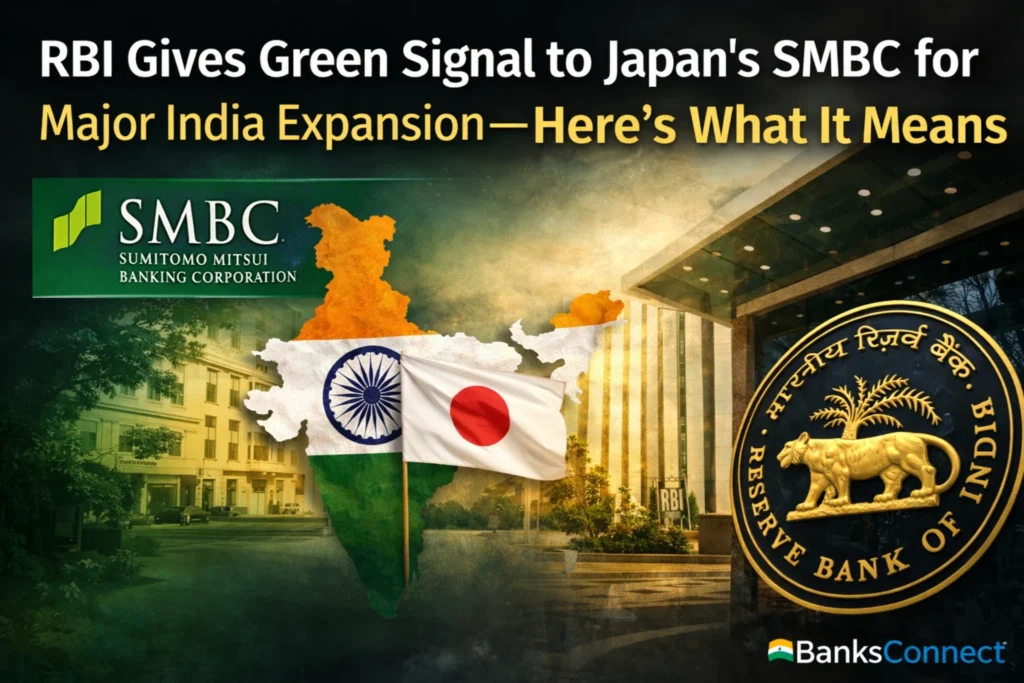

In a major boost to foreign banking in India, the Reserve Bank of India (RBI) has granted in-principle approval to Sumitomo Mitsui Banking Corporation (SMBC) of Japan to establish a wholly owned subsidiary (WOS) in the country.
This move reflects growing confidence in India’s financial sector and strengthens economic ties between India and Japan. For SMBC, it marks a new phase of deeper engagement with Indian businesses and customers.
What Is a Wholly Owned Subsidiary?
A wholly owned subsidiary is a banking company that is fully owned by a foreign parent bank but registered and regulated in India.
Unlike branch offices, a subsidiary:
- Operates as a separate legal entity
- Follows Indian banking regulations
- Can expand operations more easily
- Has greater flexibility in offering services
This structure allows foreign banks to integrate more smoothly into India’s banking system.
SMBC’s Presence in India So Far
Before this approval, SMBC was operating in India through four branches located in:
- New Delhi
- Mumbai
- Chennai
- Bengaluru
These branches mainly focused on corporate and institutional banking services, especially for Japanese companies doing business in India.
With the new subsidiary model, SMBC can now explore broader opportunities.
Why RBI’s Approval Matters
RBI’s in-principle approval is an important regulatory step. It means:
- SMBC meets RBI’s basic eligibility criteria
- The bank can now start setting up its Indian subsidiary
- Final approval will be given after compliance checks
This shows RBI’s willingness to support stable and well-regulated foreign banks in India.
Benefits of SMBC’s Subsidiary in India
1. Stronger Banking Services
SMBC can offer:
- More corporate banking solutions
- Better trade finance support
- Enhanced cross-border services
- Improved financial products for large businesses
2. Boost to India–Japan Economic Ties
Japan is one of India’s key strategic partners. SMBC’s expansion will:
- Support Japanese companies in India
- Strengthen bilateral investments
- Encourage long-term financial cooperation
3. Increased Competition in Banking
More global banks mean:
- Better service quality
- Competitive pricing
- Improved innovation
- Global best practices
This ultimately benefits Indian businesses and customers.
Connection with SMBC’s YES Bank Investment
SMBC recently invested in YES Bank, becoming a significant shareholder.
This move already showed its long-term commitment to India.
Now, with RBI approving a subsidiary, SMBC is clearly doubling down on India as a key growth market.
What Happens Next?
RBI’s Final Approval Process
Before full operations begin, SMBC must:
- Meet capital requirements
- Set up governance systems
- Ensure regulatory compliance
- Follow RBI’s operational guidelines
Once approved, the subsidiary can start banking activities officially.
What This Means for India’s Banking Sector
India’s banking market is expanding rapidly due to:
- Rising corporate demand
- Growing infrastructure projects
- Increasing global trade
- Digital transformation
Foreign banks like SMBC bring:
- International expertise
- Strong capital support
- Global network advantages
This supports India’s goal of becoming a global financial hub.
Final Thoughts
RBI’s approval for SMBC to set up a wholly owned subsidiary is a positive step for India’s financial ecosystem.
It highlights:
- India’s growing global trust
- RBI’s balanced regulatory approach
- Strong India–Japan relations
- Expanding opportunities for businesses
As SMBC prepares to begin its new journey in India, the banking sector can expect more competition, better services, and stronger international collaboration.