
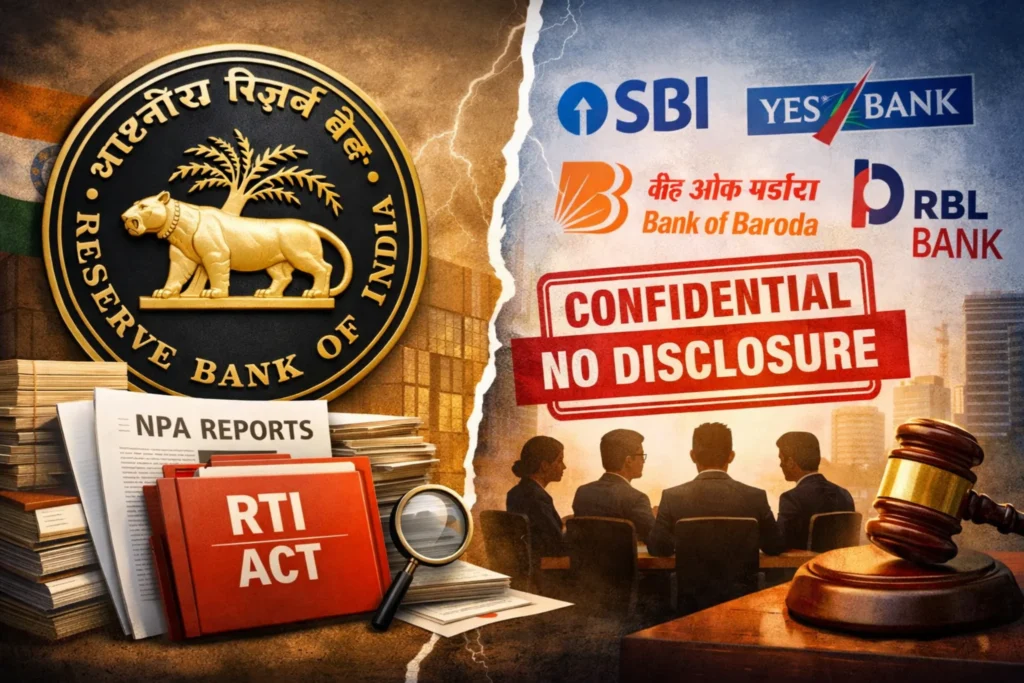

The Reserve Bank of India (RBI) has strongly advocated for greater transparency in the banking sector by supporting the disclosure of Non-Performing Asset (NPA) data, defaulters’ lists, penalties, and inspection reports under the Right to Information (RTI) Act, 2005.
However, four major banks — Bank of Baroda, RBL Bank, Yes Bank, and the State Bank of India (SBI) — have approached the Central Information Commission (CIC) to oppose this move.
This legal battle is now set to shape the future of banking transparency, depositor rights, and regulatory accountability in India.
What Triggered the RBI–Bank Dispute?
The dispute began after multiple RTI applications were filed by:
- Dheeraj Mishra
- Vathiraj
- Girish Mittal
- Radha Raman Tiwari
They sought key banking information such as:
Details Requested Under RTI
- Top 100 NPAs and wilful defaulters of Yes Bank
- Inspection reports of SBI and RBL Bank
- Records related to a ₹4.34 crore penalty imposed on Bank of Baroda after statutory inspections
After reviewing these requests, the RBI concluded that the information could be disclosed, citing binding Supreme Court judgments that favor transparency.
Banks Approach the Central Information Commission (CIC)
Unhappy with the RBI’s decision, the four banks filed appeals with the Central Information Commission (CIC), the highest authority for RTI disputes in India.
CIC Refers Case to Larger Bench
Information Commissioner Khushwant Singh Sethi:
- Referred all cases to a larger bench
- Stayed the disclosure of information until final judgment
He noted that similar cases were earlier heard by a double bench, and now require review by a larger bench for consistency and legal clarity.
The Chief Information Commissioner has been requested to constitute this bench.
RBI Rejects Claims of Commercial Harm
Under Section 11 of the RTI Act, the RBI consulted the banks as third parties.
However, the RBI rejected their claims that disclosure would:
- Harm commercial interests
- Damage competitive positioning
- Affect business reputation
The RBI relied on the Jayantilal N. Mistry Supreme Court ruling, which clearly supports public access to RBI inspection reports in the interest of transparency.
Bank of Baroda Case: Penalty and Inspection Records
In the Bank of Baroda (BoB) matter, RTI applicant Radha Raman Tiwari requested:
Information Sought
- Cases of non-compliance recorded in Statutory Inspection for Supervisory Evaluation (ISE 2021)
- Show-cause notices
- Recovery details of the ₹4.34 crore penalty
BoB argued that the information was confidential and sensitive.
RBI’s Response
The RBI dismissed the objection, stating:
“The claim that disclosure may adversely impact the bank’s business or competitive position is not tenable.”
It added that exempt information had already been removed and BoB’s objections were not sustainable.
BoB has now moved the Supreme Court seeking reconsideration of the Jayantilal N. Mistry judgment.
RBL Bank’s Objection to Inspection Reports
RBL Bank opposed the release of inspection reports for:
- 2013–14
- 2016–17
RBI’s Stand
The RBI clarified:
“There is no fiduciary relationship between the RBI and banks.”
It also cited Supreme Court contempt proceedings stating that authorities are duty-bound to provide inspection reports under RTI.
Yes Bank Opposes Disclosure of NPA Data
Yes Bank objected to the disclosure of:
- Top NPAs
- Wilful defaulters
- Inspection reports
RBI’s Clear Position
The RBI stated:
“RTI Act, 2005, overrides all earlier laws… inspection reports and other material have to be furnished.”
This reinforced the RBI’s commitment to transparency.
SBI Challenges Release of Enforcement Actions
In a separate case, State Bank of India (SBI) opposed the disclosure of:
- Show-cause notices
- Enforcement actions since April 2015
RBI’s Reply
The RBI reiterated that:
- The documents are liable to be disclosed
- Exempt portions can be removed
- Public interest outweighs confidentiality
Why This Case Matters for Indian Banking
The final decision of the CIC’s larger bench will have a major impact on:
Key Implications
- Banking transparency
- Depositor awareness
- Regulatory accountability
- Public trust in financial institutions
This case could redefine how much information about banks’ internal functioning becomes accessible to Indian citizens.
Final Thoughts
The RBI’s push for transparency reflects a growing demand for openness in financial regulation. While banks fear commercial impact, the courts and regulators continue to emphasize the public’s right to know.
The CIC’s upcoming ruling will determine the future balance between confidentiality and accountability in India’s banking system.