
For years, bank customers across India have quietly faced a common problem.
You walk into a branch for a loan — you walk out with insurance.
You open a savings account — you’re “advised” to invest in something you barely understand.
You click “continue” on a mobile app — and suddenly a product is added.
Was it compulsory?
Not always.
Was it clearly explained?
Often, no.
Now, the Reserve Bank of India (RBI) has released draft guidelines in February 2026 that directly address this issue. And this time, the tone feels different.
This isn’t just about disclosure.
It’s about accountability.
Why Mis-selling Became a Systemic Issue
Mis-selling didn’t start because bankers are unethical.
It grew because of:
- Aggressive cross-selling targets
- Fee-based revenue pressure
- Incentive structures linked to product distribution
- Digital interfaces designed to increase conversions
Over time, “advisory” became “sales pressure.”
And customers often didn’t realize the difference.
What Makes the 2026 RBI Draft Different?
Earlier circulars focused on transparency and disclosures.
This draft shifts the focus to something stronger:
👉 Customer suitability and fair conduct
The regulator is saying —
If a product is unsuitable, misleading, or forced — consent alone is not enough.
That is a major shift.
The Real Game-Changers in the Draft
Let’s understand what truly stands out.
1️⃣ Suitability Over Signature
Banks may now need to prove that:
- The product matched the customer’s profile
- Risk tolerance was considered
- Proper explanation was given
A signed form may no longer be a shield.
2️⃣ End of Forced Bundling Culture?
One of the most sensitive areas in Indian banking has been loan-linked insurance.
The draft clearly discourages coercive bundling practices.
If implemented strictly, customers may finally hear:
“Insurance is optional.”
And mean it.
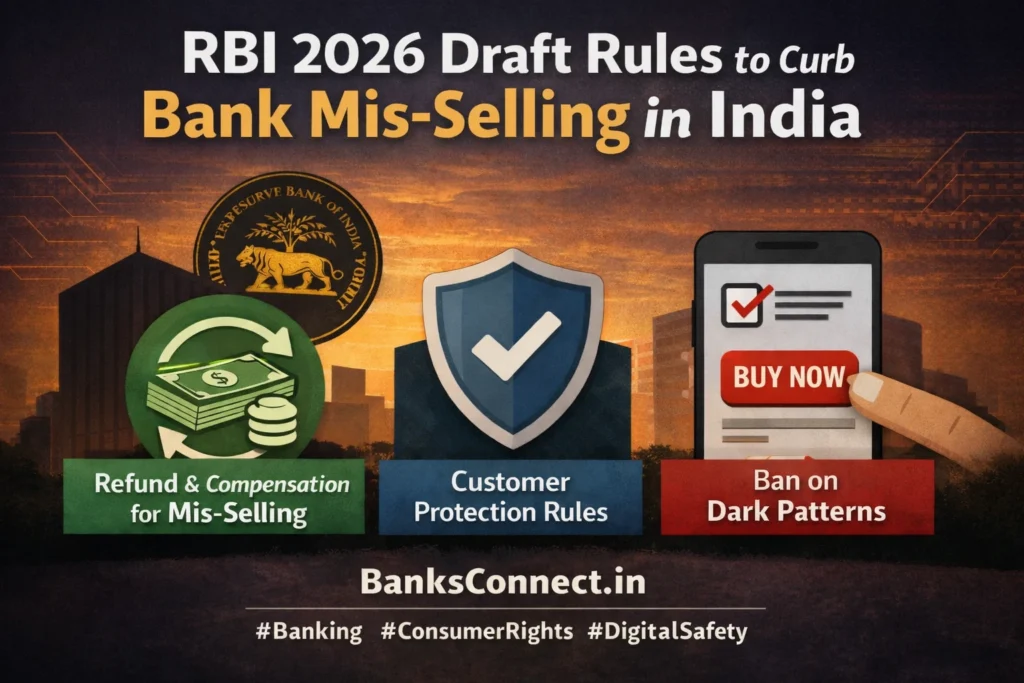
3️⃣ Digital “Dark Patterns” Under Scrutiny
This is perhaps the most modern and relevant part.
The draft targets:
- Pre-selected checkboxes
- Confusing opt-outs
- Hidden product add-ons
- Misleading app design
This signals that RBI understands how banking has moved from branch counters to mobile screens.
And mis-selling has moved with it.
4️⃣ Refund and Compensation Mechanism
This is where accountability becomes real.
If mis-selling is established:
- Refunds may be required
- Compensation for financial loss may apply
That changes the risk calculation for banks.
Mis-selling won’t just be reputational damage — it could become financial liability.
Will This Hurt Banks?
Short term — possibly.
Banks that depend heavily on third-party distribution income may face:
- Revenue adjustment
- Incentive restructuring
- Higher compliance oversight
But here’s the larger truth:
Trust is the most valuable asset in banking.
And ethical selling strengthens long-term customer relationships.
Will This Actually End Mis-selling?
Regulation alone cannot eliminate sales pressure.
The real change will depend on:
- Enforcement rigor
- Internal audit strength
- Incentive redesign
- Employee training
- Customer awareness
If sales targets remain unrealistic, pressure will simply find new forms.
The culture must evolve — not just the rulebook.
What Should Customers Do Now?
Even before final rules are implemented:
- Ask whether a product is mandatory
- Request written clarification
- Avoid signing under pressure
- Read digital screens carefully
- Use grievance redressal channels when needed
Awareness remains your strongest defense.
Final View: A Structural Reset in Progress?
The February 2026 draft by RBI feels less like a routine circular and more like a structural correction.
It acknowledges that:
- Banking has become product-driven
- Digital selling can be manipulative
- Consent does not always equal understanding
If finalized with strong enforcement, this could mark the beginning of a healthier sales culture in Indian banking.
Not because banks will stop selling.
But because they will have to sell responsibly.