
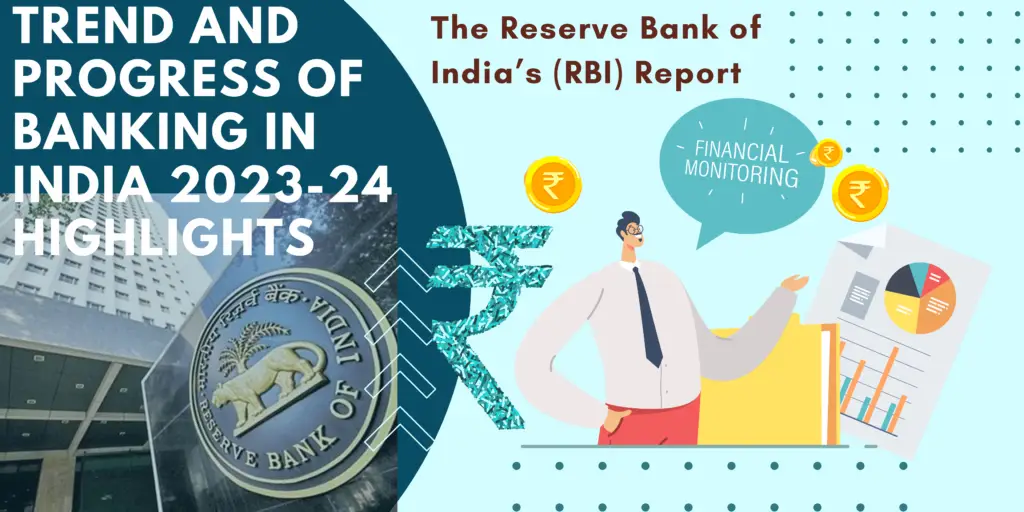


The Reserve Bank of India’s (RBI) Report on Trend and Progress of Banking in India 2023-24 highlights a year of strong performance for the Indian financial sector, with robust credit growth, improved profitability, and declining non-performing assets (NPAs). However, the report also cautions about rising risks in unsecured lending, the growing influence of private credit markets, and other vulnerabilities that could impact financial stability if not carefully managed
Banking Sector: Key Highlights
- Scheduled Commercial Banks (SCBs):
- Growth in Credit and Balance Sheets: SCBs achieved significant credit growth, leading to expanded balance sheets and strengthened capital adequacy (CRAR at 16.8% as of September 2024).
- Improved Asset Quality: Gross non-performing assets (GNPA) reached a 13-year low of 2.7% by March 2024, further reducing to 2.5% by September 2024.
- Rising Profitability: Banks marked their sixth consecutive year of profitability growth, with RoA at 1.4% and RoE at 14.6% in H1 2024-25.
- Non-Banking Financial Companies (NBFCs):
- Credit Growth and Risk Mitigation: NBFCs exhibited double-digit credit growth while improving asset quality, with GNPAs dropping to 3.4%.
- Contraction in Unsecured Lending: A focus on risk reduction led to decreased unsecured lending, reflecting a cautious stance by the sector.
- Urban Co-operative Banks (UCBs):
- Expanded their balance sheets while showing consistent improvements in asset quality and capital reserves.
RBI’s Warnings: Emerging Risks to Monitor
- Unsecured Lending Concerns:
- The report highlights the rapid expansion in unsecured loans, warning that excessive growth in this segment could lead to rising delinquencies.
- RBI has enforced stricter risk-weight norms for unsecured exposures to curb potential financial instability.
- Top-Up Loans Risks:
- RBI flagged the lax underwriting practices in top-up loans, often perceived as low-risk.
- A directive was issued to treat certain top-up loans as unsecured for credit appraisal purposes, ensuring better risk management.
- Private Credit Market Interlinkages:
- Growing interactions between banks, NBFCs, and private credit firms are raising concerns about systemic risks and regulatory arbitrage.
- Technological Challenges and Fraud Risks:
- Digital transformation has enhanced efficiency but introduced vulnerabilities like digital frauds and algorithmic biases. RBI urges financial institutions to adopt robust safeguards against such risks.
RBI’s Proactive Measures
To address these risks, RBI has introduced several measures:
- Regulatory Reforms: Stricter guidelines for unsecured and top-up loans to ensure prudent credit practices.
- Technology Integration: Promoting AI-driven monitoring systems while balancing risks like data privacy and algorithmic transparency.
- Climate Resilience: Encouraging green finance initiatives and setting up the Reserve Bank Climate Risk Information System (RB-CRIS).
Conclusion: Navigating Growth with Caution
While India’s banking sector demonstrated resilience and growth in 2023-24, the RBI’s warnings underline the need for vigilance. Managing risks in unsecured lending, private credit market interlinkages, and evolving fraud scenarios will be crucial to sustaining the sector’s positive trajectory.
By balancing innovation with caution and adhering to regulatory standards, India’s financial institutions can strengthen their foundations and support sustainable economic progress.
Stay informed with BanksConnect, your trusted source for insights into India’s financial sector.

Been playing on PHDream 88 and so far, so good! The games load fast and the payouts are on time. Plus, their customer service is actually helpful. My go-to for online gaming! Learn more here phdream 88.