
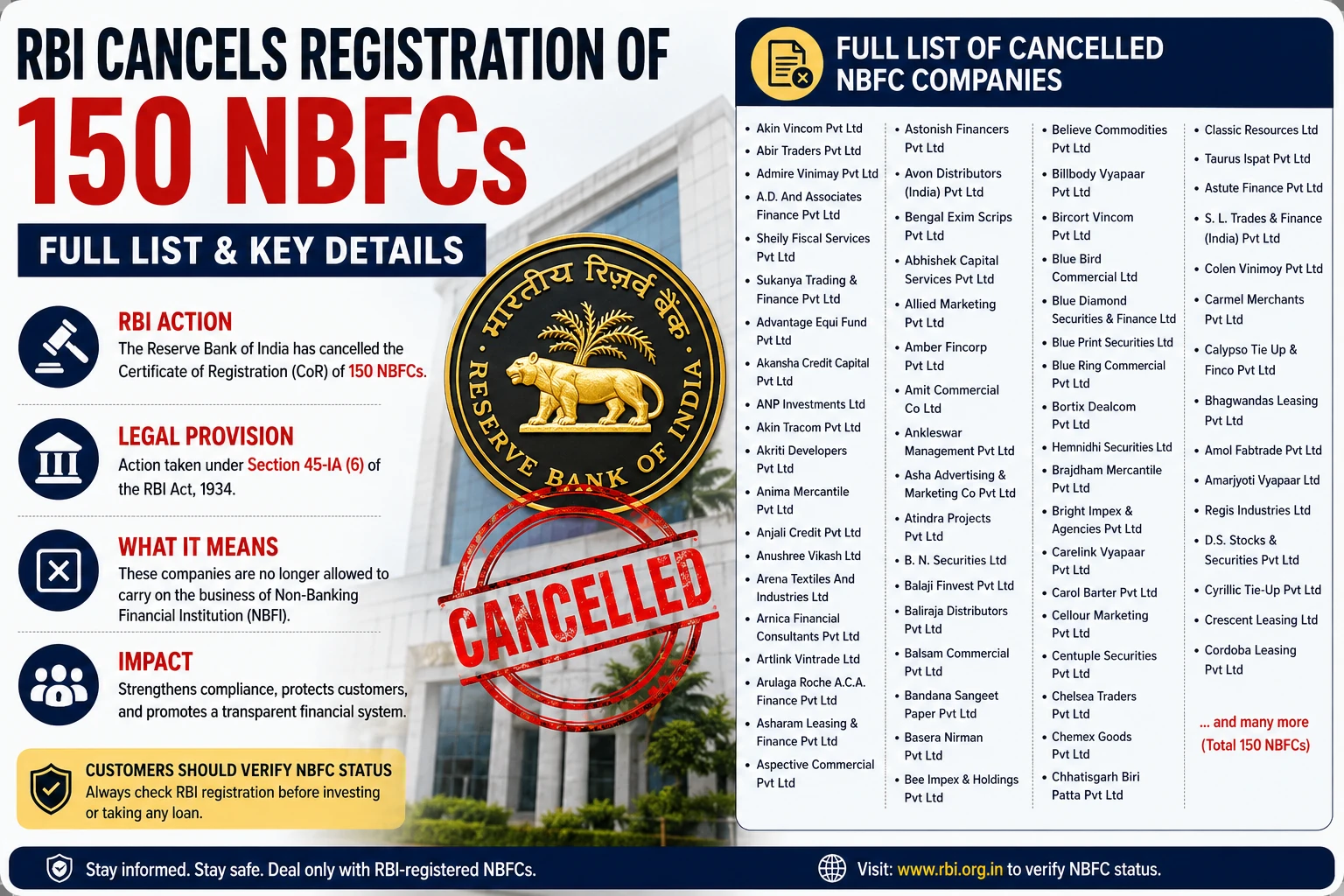

The Reserve Bank of India (RBI) has cancelled the Certificate of Registration (CoR) of 150 Non-Banking Financial Companies (NBFCs) under Section 45-IA (6) of the RBI Act, 1934. This major regulatory action highlights RBI’s continued focus on strengthening financial discipline, compliance, and transparency in India’s NBFC sector.
Why Did RBI Cancel the Registration of These NBFCs?
According to the official RBI press release, these companies are no longer allowed to conduct the business of a Non-Banking Financial Institution.
The cancellation may happen due to several reasons such as:
- Non-compliance with RBI guidelines
- Failure to maintain minimum capital requirements
- Inactive business operations
- Violation of regulatory norms
- Failure to submit mandatory returns
- Poor governance practices
The RBI regularly monitors NBFCs to ensure financial stability and protect customer interests.
What is an NBFC?
A Non-Banking Financial Company (NBFC) is a financial institution that provides services like:
- Loans and advances
- Asset financing
- Investment activities
- Gold loans
- Microfinance
- Vehicle financing
However, NBFCs cannot accept demand deposits like savings or current accounts, unlike banks.
NBFCs play an important role in improving credit access, especially in rural and semi-urban India.
Key Highlights of RBI’s Action
- RBI cancelled the CoR of 150 NBFCs in April 2026.
- Most affected companies are based in states like West Bengal, Delhi, and Telangana.
- These companies can no longer operate as NBFCs.
- The action was taken under the RBI Act, 1934.
Some notable companies mentioned in the list include:
- Akin Vincom Pvt Ltd
- ANP Investments Limited
- Abhishek Capital Services Pvt. Ltd.
- Goal Securities and Credits Limited
- HBC Finance and Leasing Ltd
- Kallarakkal Fincorp Private Limited
What Does This Mean for Customers?
Customers dealing with these companies should:
1. Verify NBFC Status
Always check whether an NBFC is registered with RBI before investing or taking loans.
2. Avoid New Transactions
These cancelled entities are no longer authorized to operate NBFC business activities.
3. Monitor Existing Loans or Investments
Customers with ongoing financial dealings should stay updated and contact the concerned company for clarification.
Impact on the Indian Financial Sector
This move shows RBI’s strict regulatory approach toward maintaining trust in India’s financial ecosystem. It may also encourage:
- Better compliance among NBFCs
- Increased transparency
- Improved customer protection
- Stronger financial governance
The action reinforces the RBI’s commitment to ensuring that only compliant and financially sound NBFCs continue operations in India.
How to Check if an NBFC is Registered with RBI?
You can verify any NBFC’s registration status through the official website of the Reserve Bank of India.
Before dealing with any financial company, customers should always confirm:
- RBI registration number
- Company status
- Regulatory compliance
Conclusion
The cancellation of registration certificates of 150 NBFCs by the Reserve Bank of India marks another important step toward strengthening India’s financial system. While genuine NBFCs continue to play a vital role in credit distribution, regulatory compliance remains essential for sustainable operations.
Financial awareness and proper verification can help customers stay safe while dealing with financial institutions.
Source: RBI Press Release 2026-2027/257