
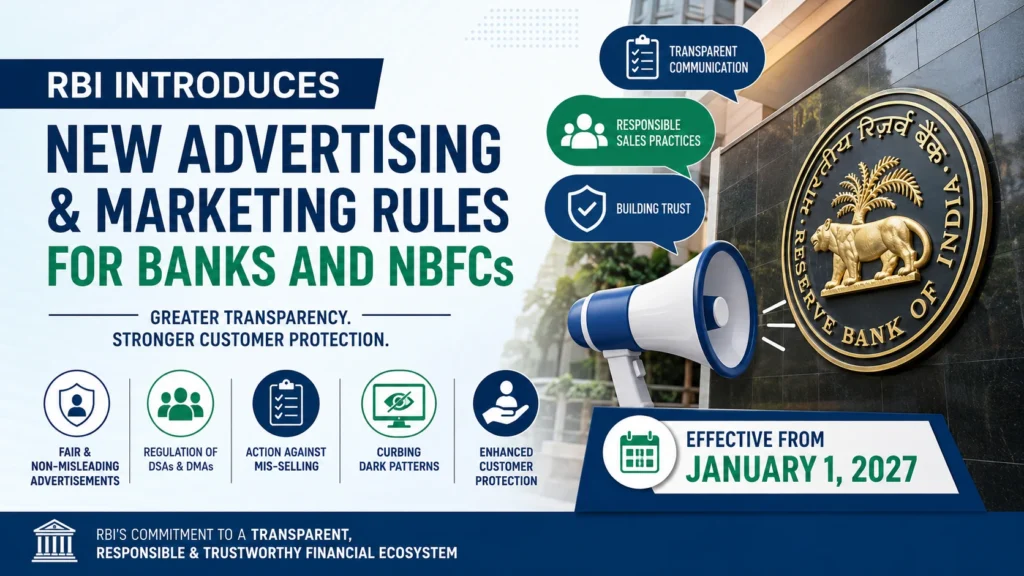

RBI Tightens Rules to Prevent Mis-selling and Misleading Financial Advertisements
The Reserve Bank of India (RBI) has introduced significant amendments to its Responsible Business Conduct framework aimed at improving transparency in the advertising, marketing, and sale of financial products and services offered by banks, NBFCs, housing finance companies, payment banks, small finance banks, cooperative banks, and regional rural banks.
The new regulations will come into force from January 1, 2027, and are expected to strengthen customer protection while reducing instances of mis-selling in the financial sector.
Why Did RBI Introduce These Changes?
In its Statement on Developmental and Regulatory Policies issued on February 6, 2026, RBI proposed a comprehensive framework to regulate how financial institutions advertise and market their products. Draft guidelines were released on February 11, 2026, seeking stakeholder feedback. After reviewing comments from banks, NBFCs, industry associations, and other stakeholders, RBI has finalized the amendment directions.
The objective is to ensure that customers receive clear, fair, and transparent information before purchasing financial products.
Key Highlights of RBI’s New Guidelines
1. Stronger Control on Financial Advertisements
Banks and NBFCs must ensure that advertisements are:
- Fair and transparent
- Non-misleading
- Free from exaggerated claims
- Clear about risks and charges
The move aims to prevent customers from being influenced by incomplete or deceptive marketing messages.
2. Regulation of DSAs and DMAs
The RBI has specifically addressed the role of Direct Selling Agents (DSAs) and Direct Marketing Agents (DMAs), who are widely used by banks and NBFCs for customer acquisition.
Financial institutions will now be responsible for ensuring that their agents:
- Follow ethical sales practices
- Do not make false promises
- Provide accurate product information
- Avoid aggressive selling techniques
This is particularly important for retail loans, credit cards, insurance, and investment products.
3. Action Against Mis-selling
Mis-selling has been a growing concern in India’s financial sector. RBI’s revised framework focuses on:
- Customer suitability assessment
- Transparent disclosures
- Fair sales practices
- Proper documentation of customer consent
The guidelines aim to ensure that customers buy products that genuinely match their financial needs.
4. Restrictions on Dark Patterns
For the first time, RBI has highlighted concerns around “dark patterns” in digital financial services.
Dark patterns refer to website or app designs that manipulate users into making decisions they may not otherwise choose, such as:
- Hidden charges
- Pre-selected options
- Confusing cancellation processes
- Misleading discount claims
The new framework seeks to curb such practices across regulated financial entities.
5. Better Customer Protection
The amendments emphasize responsible conduct throughout the customer journey, including:
- Product advertising
- Lead generation
- Sales process
- Post-sale communication
This will improve customer trust and accountability across the financial ecosystem.
RBI Also Amends Rules on Agency Business and Referral Services
Apart from advertising guidelines, RBI has also revised the framework governing “Agency Business and Referral Services” undertaken by regulated entities.
The central bank reviewed stakeholder feedback and incorporated necessary modifications into the final directions. These amendments will also become effective from January 1, 2027.
Which Financial Institutions Will Be Covered?
The amended directions apply to:
- Commercial Banks
- Small Finance Banks
- Payment Banks
- Local Area Banks
- Regional Rural Banks
- Urban Cooperative Banks
- Rural Cooperative Banks
- All India Financial Institutions
- Non-Banking Financial Companies (NBFCs)
- Housing Finance Companies (HFCs)
Impact on Customers
For customers, the new RBI framework is expected to bring:
Greater Transparency
Customers will receive clearer information about fees, charges, risks, and benefits.
Reduced Mis-selling
Financial products will be sold under stricter compliance standards.
Improved Digital Experience
Banks and NBFCs will need to eliminate deceptive online practices and dark patterns.
Better Consumer Protection
Customers will have stronger safeguards against misleading sales tactics.
Impact on Banks, NBFCs and DSAs
Financial institutions will need to:
- Review marketing campaigns
- Update sales processes
- Train employees and agents
- Strengthen compliance monitoring
- Revise digital customer journeys
DSAs and DMAs may face stricter supervision and accountability requirements under the revised framework.
Conclusion
RBI’s latest amendment directions represent a major step toward responsible financial marketing and customer-centric banking practices. By addressing mis-selling, regulating DSAs, and curbing dark patterns, the central bank aims to create a more transparent and trustworthy financial ecosystem.
The new regulations will take effect from January 1, 2027, giving banks, NBFCs, and other regulated entities sufficient time to align their policies and operational practices with RBI’s expectations.